SMED Excel template: analyse your changeover
Every changeover is stopped machine time. This template applies the SMED method without a consultant: time it, split internal from external and calculate by itself the difference in minutes per change.
What you get
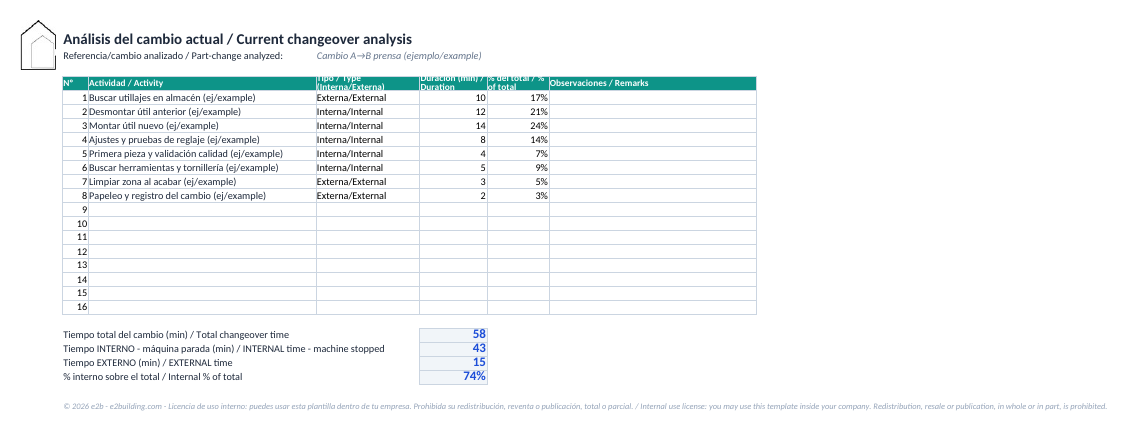
→ Current changeover analysis
Time every activity of the changeover and mark it internal or external. The template sums times and percentages by itself.
→ Internal vs external, in plain sight
You'll see the number that changes everything: how many minutes are done with the machine stopped that could be done with it running.
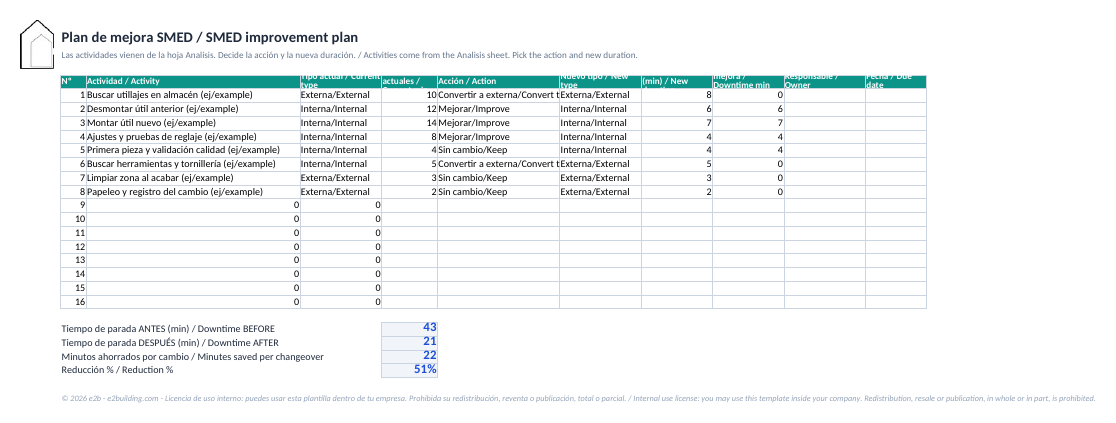
→ SMED improvement plan
For each activity you decide: convert to external, improve or keep. With owner and new duration.
→ Before and after, calculated
Downtime before, downtime after, minutes saved and % reduction come out by themselves. The argument for your boss, done.
→ Real pre-filled example
An illustrative A→B press changeover with sample times to explain the method, not a customer result.
→ PDF guide (4 pages)
The SMED method explained without jargon, how to time without making anyone nervous and classic mistakes. EN/ES.
Single bilingual file: headers and instructions in Spanish and English. Calculation cells are locked so nobody breaks the formulas; you only type in the input cells.
What it looks like inside
How it works
- Pick a frequent changeover and time every activity once (phone and stopwatch, nothing else).
- Mark each activity as internal (machine stopped) or external (machine running). You'll see where the time goes.
- Decide an action per activity: anything that can be done externally goes out; the internal ones get improved.
- Compare before and after on the same basis. Review tasks and constraints; no percentage reduction is guaranteed.
SMED helps separate internal and external tasks and test improvements. Results depend on the process, constraints and actions implemented.
Who it's for
For the production or continuous improvement manager of an industrial SME with frequent changeovers (presses, injection moulding, machining, packaging) who knows time is lost in changeovers but has never measured it with method.